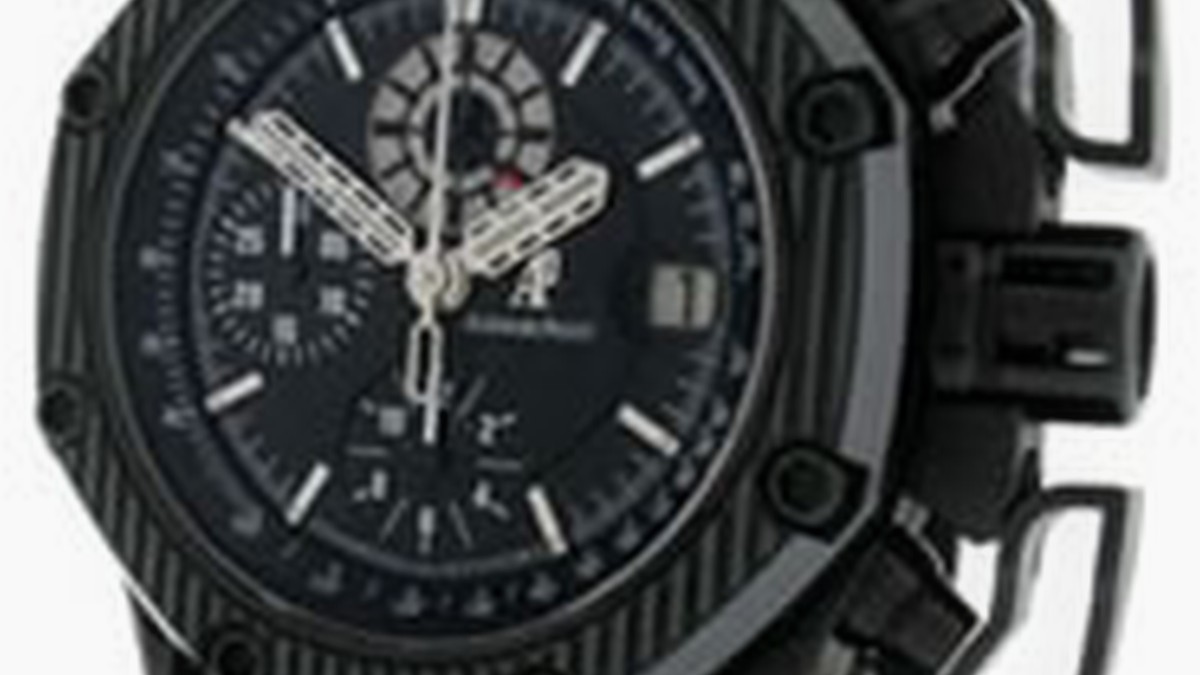
They share a bezel language, not a wearing experience
The Royal Oak and Royal Oak Offshore are visually related, but treating the Offshore as simply a larger Royal Oak misses the important differences. The classic Royal Oak is defined by an integrated bracelet, thinner case architecture and a more restrained dial. The Offshore adds mass, chronograph hardware, larger dial texture and frequently rubber straps or interchangeable strap systems.
Case architecture changes the whole comparison
| Feature | Royal Oak | Royal Oak Offshore |
|---|---|---|
| Typical modern focus | 39–41 mm integrated-bracelet models | Larger sports chronographs, including current 43 mm 26420 |
| Dial texture | Petite/Grande Tapisserie depending on reference | Méga Tapisserie common |
| Strap/bracelet | Integrated bracelet is central to identity | Rubber/leather straps common; some bracelet references exist |
| Movement impact | Ranges from thin time/date to 41 mm chronograph | Chronograph architecture often central |
| Visual failure point | Case/bracelet transitions | Thickness, pusher/crown geometry and subdials |
Royal Oak: finishing errors have nowhere to hide
A simple Royal Oak can look less complex than an Offshore, yet it can be harder to execute convincingly. The broad brushed surfaces, polished bevels, bezel edges and integrated bracelet all meet in a small area. If the first bracelet link angles incorrectly or the brushing changes direction at the wrong place, the mistake is visible without opening the caseback.
Offshore: architecture matters more than visual noise
Offshore models can initially hide minor finishing errors because the watch is busier. But chronograph layout, pushers, crown guards, case thickness and strap integration create stronger technical tests. The current 43 mm 26420 family uses Calibre 4401 as a genuine baseline, with flyback chronograph architecture and a 70-hour power reserve. A replica does not need to reproduce that calibre to be useful, but its visible layout should be judged against the specific reference it claims to imitate.
Which is easier to wear?
The answer is not just diameter. A Royal Oak’s first bracelet links extend the visual footprint beyond the case, while an Offshore adds thickness and strap/case mass. Someone comfortable with a 41 mm round watch may still find a 41 mm Royal Oak visually broad. A 43 mm Offshore is a larger commitment again.
Which is easier to buy well?
For many buyers, a simple Royal Oak with a reliable automatic movement is mechanically less complicated than an Offshore chronograph. But the Royal Oak demands better bracelet and case finishing. Offshore buyers need to pay more attention to movement layout and function. The “easier” choice depends on which errors bother you more.
Decision shortcut
- Choose Royal Oak if integrated bracelet finishing, cleaner proportions and a thinner visual profile are the priority.
- Choose Royal Oak Offshore if you want stronger wrist presence, chronograph styling and rubber/strap versatility.
- Choose neither based only on a factory tier; compare the exact reference family and QC evidence.
Dial readability and wrist presence pull in opposite directions
The Offshore’s larger case and stronger contrast can make the watch easier to read at a glance, particularly on references with large markers and high-contrast chronograph counters. The trade-off is visual mass. A classic Royal Oak is quieter and more integrated, but small finishing inconsistencies can become more obvious because there are fewer dramatic elements competing for attention.
This matters when looking at seller photography. A busy Offshore image can flatter a mediocre watch, while a simple Royal Oak photo can expose every edge. Compare both models under the same neutral-light standard.
Serviceability can change the answer
If you expect to wear the watch frequently, movement serviceability may outweigh visual similarity. A simpler Royal Oak with a widely serviceable automatic movement may be easier to own than a complicated Offshore chronograph. Buyers who prioritize reference architecture may accept the opposite trade-off. Neither preference is inherently superior; what matters is knowing which compromise you are making.
Buying intent is the best tie-breaker
If both designs appeal equally, imagine how the watch will be used. An office or everyday piece that needs to slide under a cuff points toward a thinner Royal Oak. A casual sports watch where the case and strap are meant to be noticed points toward the Offshore. This use-case test is often more useful than debating which family is “more accurate” in replica form.
The choice also changes what you should spend money on. Royal Oak buyers often benefit from better bracelet and case finishing; Offshore buyers may gain more from a stronger chronograph architecture, better strap system or more accurate case profile.